









The True Meaning Behind Bhagat Singh’s Revolutionary Spirit

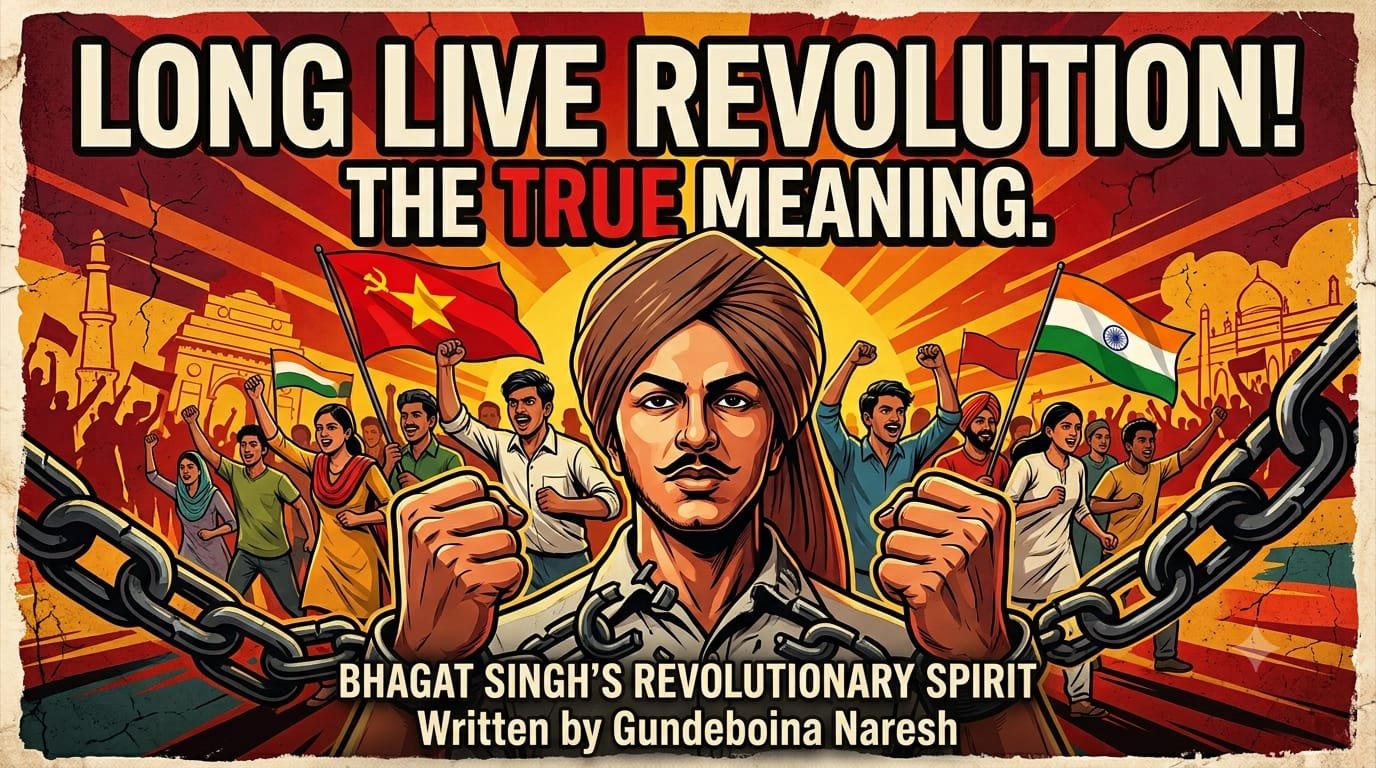
Long Live Revolution” — Inquilab Zindabad.
These words are often associated with Bhagat Singh and the revolutionary movement of India. But what did Bhagat Singh actually mean when he raised this powerful slogan?
In his letter to the editor of Modern Review, Bhagat Singh and B.K. Dutt explained that the phrase should not be understood literally. “Long Live Revolution” did not mean that violence or bloodshed should continue forever. It represented something much deeper—the spirit of change, progress and the constant struggle for a better society.
Bhagat Singh explained that revolution was not simply a cult of bombs and pistols. Weapons, he argued, could sometimes become a means, but they were not the revolution itself. A rebellion and a revolution were not necessarily the same thing.
For him, the real meaning of revolution was the longing for change for the better.
Human beings can become comfortable with an existing system, even when that system is unjust. Over time, people may begin to fear change and accept inequality, exploitation and injustice as normal. Bhagat Singh believed that this mentality—this intellectual and social stagnation—had to be challenged.
The revolutionary spirit, therefore, was not merely about overthrowing a government. It was about awakening people.
It was about questioning what was wrong.
It was about refusing to accept injustice simply because it had existed for a long time.
It was about creating the courage to imagine something better.
Bhagat Singh also gave a beautiful explanation through the example of the slogan “Long Live Jatin Das.” Nobody meant that Jatin Das should physically live forever. The words represented the survival of his ideals, his courage and his spirit of sacrifice.
In the same way, “Long Live Revolution” meant that the revolutionary spirit should continue to live.
Bhagat Singh feared that when reactionary forces become powerful and society stops questioning the established order, progress itself begins to suffer. He believed that humanity must always have the courage to move forward.
His message was essentially this:
The old order must make way for the new when the new represents progress, justice and human dignity.
That is why the slogan continues to carry meaning even decades after Bhagat Singh’s death.
For the young revolutionary, revolution was not simply an event that happened on a particular day. It was a living spirit—a spirit that challenges injustice, rejects stagnation and keeps humanity moving forward.
Bhagat Singh was only 23 when he was executed, but his thoughts were far older than his years. His words remind us that true revolution begins not with a weapon in the hand, but with a question in the mind.
“Why should things remain the same when they can be made better?”
That question itself can become revolutionary.
And perhaps that is the deeper meaning behind the words:
INQUILAB ZINDABAD — LONG LIVE REVOLUTION.